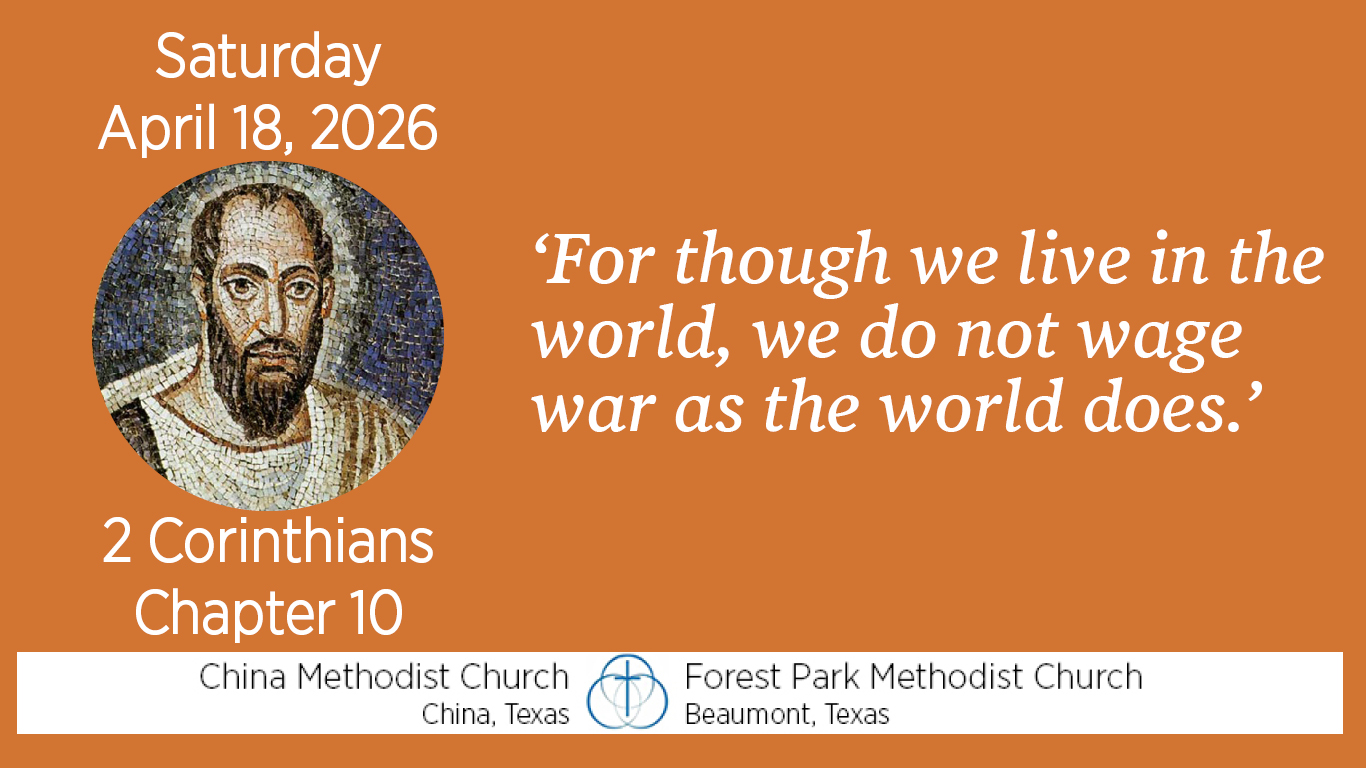
Waging war
Day 615, Saturday, April 18
2 Corinthians Chapter 10
Chapter 10 begins much in the tone we’ve seen before: “By the humility and gentleness of Christ I appeal to you…” But we quickly see a more argumentative tone as Paul appears to quote accusations that have been leveled against him, “I, Paul, who am ‘timid’ when face to face with you, but ‘bold’ toward you when away!”
He continued, “I beg you that when I come I may not have to be as bold as I expect to be toward some people who think that we live by the standards of this world.”
We don’t know exactly who the “some people” are that he refers to, but later verses suggest they are other Christian teachers who were critical of Paul while building themselves up. That’s supported in verse 18 with, “For it is not the one who commends himself who is approved, but the one whom the Lord commends.”
After what we’ve read already about Paul’s belief that we have a ministry of reconciliation, we can learn from seeing how Paul responds to conflict himself.
Doing battle in the Christian realm, to Paul, differs from doing battle in the worldly realm. “For though we live in the world, we do not wage war as the world does,” he said. “The weapons we fight with are not the weapons of the world. On the contrary, they have divine power to demolish strongholds. We demolish arguments and every pretension that sets itself up against the knowledge of God, and we take captive every thought to make it obedient to Christ.”
If we really believe that history represents a battle between good and evil—between God and sin—then we have to acknowledge that spiritual warfare is as real as physical warfare—maybe more real.
We are left with the question of how the Christian relates to worldly warfare. It’s a question that has been debated for centuries and continues to be debated
It’s a question that we would like to have had more guidance about from Paul and from Jesus himself. But they lived in a day when the Roman army was controlled by the pagan government; Christians had no influence over if or when the nation went to war. They few references we have make it clear that there were faithful Christians who served in the army, but they were not the ones making the decisions at the top.
Paul seems to be saying that spiritual warfare—the fight against sin and evil—is fought with different weapons and on a different battleground than worldly war.
What this means in a world in which Christians have influence at least to some degree over worldly wars is debatable. It can be argued that Christians can, or even should, go to war for worldly, but righteous, causes. It would be harder to justify the use of worldly warfare for fighting spiritual battles.
Saturday meditation
Psalms 111:1-10
Praise the Lord.
I will extol the Lord with all my heart in the council of the upright and in the assembly.
Great are the works of the Lord; they are pondered by all who delight in them. Glorious and majestic are his deeds, and his righteousness endures forever. He has caused his wonders to be remembered; the Lord is gracious and compassionate. He provides food for those who fear him; he remembers his covenant forever.
He has shown his people the power of his works, giving them the lands of other nations. The works of his hands are faithful and just; all his precepts are trustworthy. They are established for ever and ever, enacted in faithfulness and uprightness. He provided redemption for his people; he ordained his covenant forever—holy and awesome is his name.
The fear of the Lord is the beginning of wisdom; all who follow his precepts have good understanding. To him belongs eternal praise.
Prayer focus
Your world if full of war. Show us how you would have us respond.
-Rev. Mark Fleming