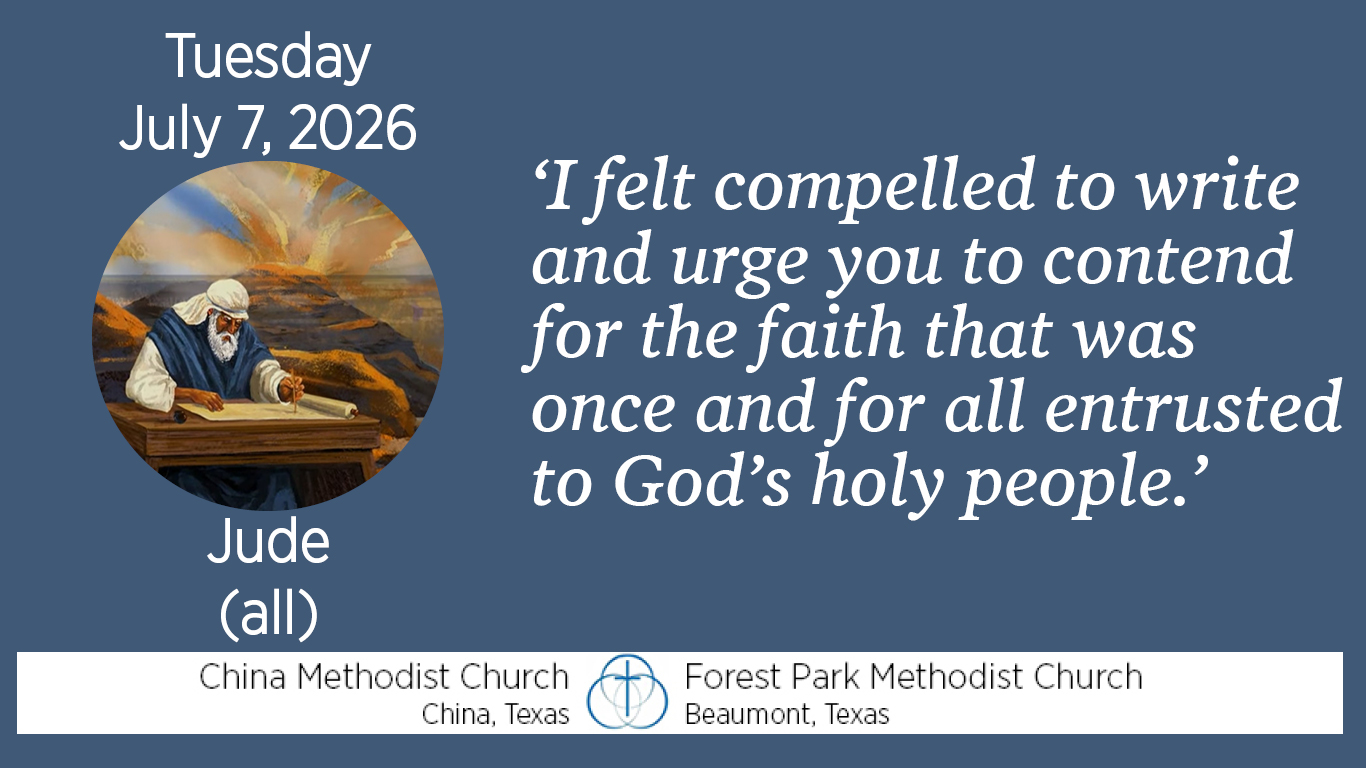
Contend for the faith
Day 695, Tuesday, July 7
Jude (all)
In the weeks before I wrote this, the Presbyterian Church (USA) was in the news when its governing body considered a resolution that would have removed the requirement that sexually active clergy be in monogamous relationships. That denomination, like several other mainline liberal denominations, has already removed its guidance against homosexual relationships. The resolution was not adopted, but was referred for further study.
A podcast I recently listened to (from a different part of the theological spectrum) specifically discussed Jude verse 3: “Dear friends, although I was very eager to write to you about the salvation we share, I felt compelled to write and urge you to contend for the faith that was once and for all entrusted to God’s holy people.” The podcast participants suggested that the word “contend” is too mild a translation—that “fight hard for” would be more accurate.
While the podcast wasn’t specifically about the monogamy/polyamory controversy, it seemed to line up, especially in light of verse 4: “For certain individuals whose condemnation was written about long ago have secretly slipped in among you. They are ungodly people, who pervert the grace of our God into a license for immorality and deny Jesus Christ our only Sovereign and Lord.
Arguing over every question or detail of doctrine can be counterproductive, but we should be willing to contend—even fight hard—against claims that fundamentally twist the Christian message into something it is not.
God’s grace brings freedom from sin, not freedom to sin.
Jesus Christ is, always has been, and always will be, our only Sovereign and Lord.
-Rev. Mark Fleming
Tuesday meditation
Ecclesiastes 5:8 – 6:2
If you see the poor oppressed in a district, and justice and rights denied, do not be surprised at such things; for one official is eyed by a higher one, and over them both are others higher still. The increase from the land is taken by all; the king himself profits from the fields.
Whoever loves money never has enough; whoever loves wealth is never satisfied with their income. This too is meaningless.
As goods increase, so do those who consume them. And what benefit are they to the owners except to feast their eyes on them?
The sleep of a laborer is sweet, whether they eat little or much, but as for the rich, their abundance permits them no sleep.
I have seen a grievous evil under the sun: wealth hoarded to the harm of its owners, or wealth lost through some misfortune, so that when they have children there is nothing left for them to inherit. Everyone comes naked from their mother’s womb, and as everyone comes, so they depart. They take nothing from their toil that they can carry in their hands.
This too is a grievous evil: As everyone comes, so they depart, and what do they gain, since they toil for the wind? All their days they eat in darkness, with great frustration, affliction and anger.
This is what I have observed to be good: that it is appropriate for a person to eat, to drink and to find satisfaction in their toilsome labor under the sun during the few days of life God has given them—for this is their lot. Moreover, when God gives someone wealth and possessions, and the ability to enjoy them, to accept their lot and be happy in their toil—this is a gift of God. They seldom reflect on the days of their life, because God keeps them occupied with gladness of heart.
I have seen another evil under the sun, and it weighs heavily on mankind: God gives some people wealth, possessions and honor, so that they lack nothing their hearts desire, but God does not grant them the ability to enjoy them, and strangers enjoy them instead. This is meaningless, a grievous evil.
Prayer focus
Grant us the wisdom and courage to contend for the faith.