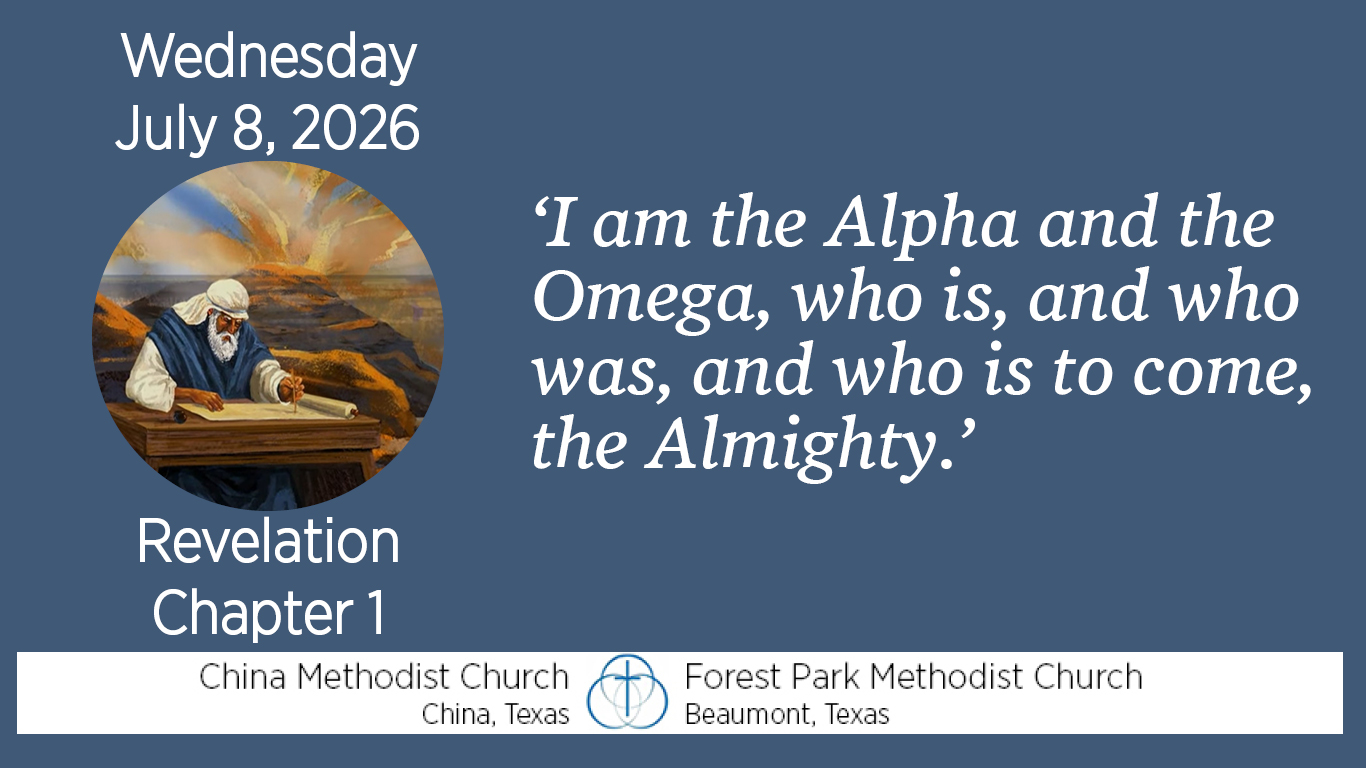
Word and testimony
Day 696, Wednesday, July 8
Revelation Chapter 1
I have often imagined how the opening verses of Genesis should be pictured in a movie, as God creates the heavens and the earth in the beginning. I think of blackness slowly becoming light, swirling into galaxies and stars and planets in IMAX-worthy special effects as orchestral music swells.
I see Revelation much the same way: Awe-inspiring images that barely hint at reality far beyond our comprehension. Anyone who claims to have the book completely figured out raises suspicion.
With that being said, let’s try to learn what we can.
The writer identifies himself only as “John.” It’s a common name, so there’s a lot of speculation about if it was John the evangelist, John the brother of Jesus, or someone else. It was written from the island of Patmos, so scholars usually refer to the writer as John of Patmos. The time of writing is usually placed about A.D. 95 or within a few years after that.
Current academic scholars largely agree that most of the events in Revelation, other than the final return of Jesus and the bringing of the Kingdom of God, had already occurred by the time it was written. That doesn’t mean it has nothing to teach us, but it does remove the emphasis on using it to predict world events that sensationalist interpretations give it.
In the first three verses we see that John is reporting on a vision he has seen that has been given to him by Jesus, who in turn received it from God. It is the word of God and the testimony of Jesus Christ.
Many Christians at the end of the first century were suffering from turmoil in the Roman Empire, and also from persecution directed particularly toward them. Revelation was written to encourage them to endure and remind them that God is still God and God will prevail in the end. Or, in the words of 1:8, “I am the Alpha and the Omega,” says the Lord God, “who is, and who was, and who is to come, the Almighty.”
-Rev. Mark Fleming
Wednesday meditation
Ecclesiastes 6:3-12
A man may have a hundred children and live many years; yet no matter how long he lives, if he cannot enjoy his prosperity and does not receive proper burial, I say that a stillborn child is better off than he. It comes without meaning, it departs in darkness, and in darkness its name is shrouded. Though it never saw the sun or knew anything, it has more rest than does that man—even if he lives a thousand years twice over but fails to enjoy his prosperity. Do not all go to the same place?
Everyone’s toil is for their mouth, yet their appetite is never satisfied. What advantage have the wise over fools? What do the poor gain by knowing how to conduct themselves before others? Better what the eye sees than the roving of the appetite. This too is meaningless, a chasing after the wind.
Whatever exists has already been named, and what humanity is has been known; no one can contend with someone who is stronger. The more the words, the less the meaning, and how does that profit anyone?
For who knows what is good for a person in life, during the few and meaningless days they pass through like a shadow? Who can tell them what will happen under the sun after they are gone?
Prayer focus
Remind us in difficult times that you are with us, have always been with us, and will always be with us.