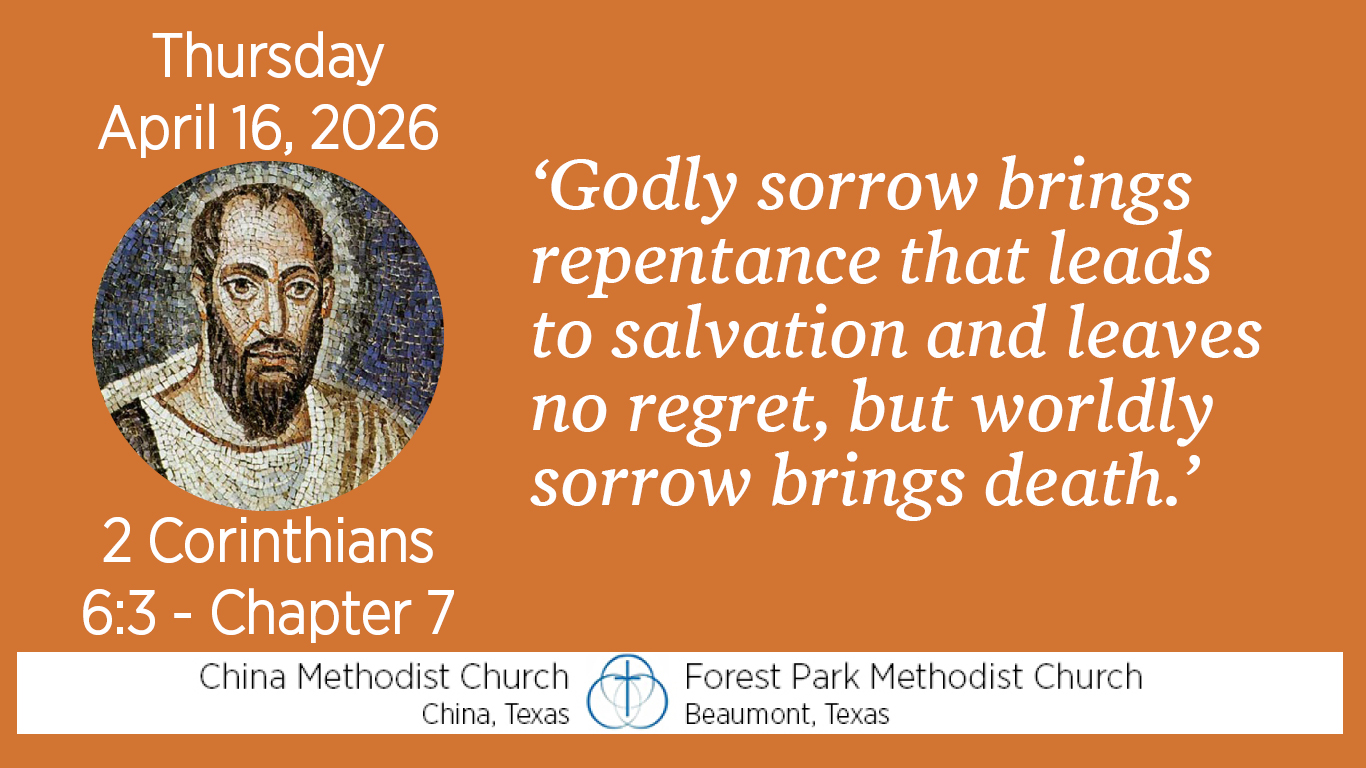
Godly sorrow
Day 613, Thursday, April 16
2 Corinthians 6:3 – Chapter 7
One of the most destructive, and unfounded, misunderstandings of Christianity is that the Christian faith encourages feelings of guilt. Guilt feelings are part of the human condition, regardless of whether or not a person is a follower of Christ. Whether we call it overthinking or depression or regret, feelings of guilt weigh on most people. And all too often it leads literally to death.
While not using the word itself, Paul addresses guilt in today’s reading—and we see that Christianity provides the solution, not the problem.
Paul again in verse 8 refers to a painful letter that caused sorrow—the kind of sorrow that we typically call guilt, which is regret for something we have done or left undone. He says, though, that he is glad of it, because the sorrow it caused led to repentence. “For you became sorrowful as God intended and so were not harmed in any way by us.”
How did God intend us to feel sorrowful (or guilty)?
“Godly sorrow brings repentance that leads to salvation and leaves no regret, but worldly sorrow brings death.”
Sorrow isn’t intended to be where we stay. Instead, it is intended to lead us to turn around. If our hand gets near the hot burner of a stove, we aren’t meant to keep it there and suffer from the heat; we’re meant to pull back and move away from harm.
That’s what Godly sorrow does—its pain warns us that it’s time to move in a different direction. God inivites us to respond to sorrow for our failings by changing course and leaving the pain behind.
Today’s reading also contains a caution, “Do not be yoked together with unbelievers.”
The caution is often seen as advice not to marry an unbeliever. While marriage to an unbeliever can lead to problems, the advice is more general than that: we should avoid close entanglements with unbelievers.
Paul makes it clear elsewhere that we cannot avoid all interactions with unbelievers, and shouldn’t try to, but the closer those relationships are the more likely they are to present challenges to faithful living.
-Rev. Mark Fleming
Thursday meditation
Psalms 109:16-31
For he never thought of doing a kindness, but hounded to death the poor and the needy and the brokenhearted. He loved to pronounce a curse—may it come back on him. He found no pleasure in blessing—may it be far from him. He wore cursing as his garment; it entered into his body like water, into his bones like oil. May it be like a cloak wrapped about him, like a belt tied forever around him. May this be the Lord’s payment to my accusers, to those who speak evil of me.
But you, Sovereign Lord, help me for your name’s sake; out of the goodness of your love, deliver me. For I am poor and needy, and my heart is wounded within me. I fade away like an evening shadow; I am shaken off like a locust. My knees give way from fasting; my body is thin and gaunt. I am an object of scorn to my accusers; when they see me, they shake their heads.
Help me, Lord my God; save me according to your unfailing love. Let them know that it is your hand, that you, Lord, have done it. While they curse, may you bless; may those who attack me be put to shame, but may your servant rejoice. May my accusers be clothed with disgrace and wrapped in shame as in a cloak.
With my mouth I will greatly extol the Lord; in the great throng of worshipers I will praise him. For he stands at the right hand of the needy, to save their lives from those who would condemn them.
Prayer focus
Search our hearts, Lord, and make us aware of our sin, not that we may be lost in grief, but that we might find freedom in your great grace.